
Assert Yourself!
© copyright 2017 by Lynette J. Hoy, NCC, LCPC as published in the Godly Business Woman’s Magazine
The Problem with non-assertiveness
What is Assertiveness?
The importance of using paraphrasing skills
Assertive skills
A-S-E-R-T Model
Assertiveness tape and Proven Strategies to build great Relationships
If you’re like most people you tend to be fairly indirect about expressing your feelings and needs. Perhaps as a child you were taught it was self-centered to talk about yourself. Maybe you’re afraid to be direct, fearing people will be put off or you will run into conflict. You may end up being so indirect that you let others speak for you. When you share your thoughts and feelings in a round-about-way, you are apt to sound something like this: “They just laid off most of my department . . . it’s kind of . . . . well, you know. . . . but, what can you do?” When you can’t express your wants openly, you have to hint, “It looks like a nice day . . . . our neighbors went to play tennis.” Or, “the newspaper mentioned an arts and crafts show this Sunday.” and hope your friend or spouse will pick up on it.
Maybe instead of passivity you have a problem with anger and aggressiveness. You blow up when someone disappoints you or you don’t get your way. You don’t want to let people treat you unfairly and you let them know it but with regret later on.
As a Christian it’s difficult to decide when to stand up for your “reasonable rights” and state your opinion, or when to go the extra mile considering others’ interests. You may end up apologizing for someone else’s mistakes. When someone spills their coffee on you- you say you’re sorry for being in the wrong place. When someone puts you down- you pretend you’re deaf. When others openly state their values and beliefs- you keep quiet rationalizing that “the Holy spirit didn’t lead you to say anything”. If you’re lucky and happen to have a very attentive listener, he or she may understand your thoughts and feelings and draw them out of you. If you’re not lucky, you and your opinion will be overlooked because you kept quiet.
So whether you tend to be indirect, aggressive or passive your relationships aren’t satisfying and issues aren’t resolved. Assertiveness doesn’t leave communication or issues in relationships up to chance.
What is assertiveness? It’s a way of confronting the unpleasant or difficult without getting squashed or squashing others in the process. When you use assertiveness you can negotiate reasonable changes by stating directly what you think, feel and want. Assertiveness builds intimacy, solves interpersonal problems and increases honesty, requests and refusals in your relationships.
Assertiveness is biblical! Paul writes about the importance of “speaking the truth in love” and “speaking truthfully to your neighbor” in Ephesians 4, verses15 and 29. In John 4:17-18 Jesus said to the Samaritan woman, “You are right when you say you have no husband. The fact is, you have had five husbands, and the man you now have is not your husband”. (NIV) Pretty direct, huh?
Of course, you can choose any number of alternatives to assertiveness. You can fake your feelings, suffer silently, retreat from others, manipulate them or demand your way. Ultimately these options are self-defeating and harmful to relationships.
Paraphrasing: One of the keys to making assertiveness work for you while making it palatable for others is to combine it with active listening. Listening involves hearing and paraphrasing back what someone says to you. It gives you the opportunity to pick up on their viewpoints and continue the dialogue. You don’t have to agree with their opinions, but active listening will show that you value and respect them. This will increase the odds that others will take time to listen to you.
Begin summarizing what people say to you with these phrases:
•”In other words . . . ”
•”Let me get this straight . . . ”
•”So you felt that . . . ”
•”What I hear you saying is . . . ”
•”If I understand you correctly . . . ”
•”Would you say that . . . ?”
•”Do I understand you to mean . . . ?”
Make certain that your paraphrase is brief and includes the facts and feelings the person is expressing. Some sample paraphrases might be:
•”So you felt really scared when the dog ran in front of the car.”
•”In other words, you feel frustrated because I missed our appointment.” When you can summarize what someone has said to you . . . you will earn a hearing with them.
Assertiveness Skills: Still, the most difficult aspect of communication comes when you take the risk to talk about your opinions, feelings and needs. Don’t let fear hold you back! Pray and ask the Lord to give you the courage to “speak the truth in love.” St. Paul wrote in Philippians 4:13, “I can do all things through Him (Christ) Who strengthens me”. (NIV) As a Christian, you have the greatest spiritual power in the world residing within you to help you speak up within the bounds of love. Learning assertive communication skills is the next step. Here are some examples of assertiveness which will help you express your opinions, confront others, state your feelings or make requests:
1. Stating your preference or opinion; “My preference is______. “What I’d like is______”
2. Expressing you feelings; “I feel_______when ______________
3. Making requests: “This movie is not what I hoped it would be. I would like to leave.”
4. Disagreeing with someone; “I disagree with you when you say _____________.
5. Saying yes or no without making excuses; “I am unable to come to lunch (or that church function).”
6. “I” statements for confronting: “I feel______when you_______ because__________.
A..sk for God’s Help: Pray for God to guide you through scripture and His Spirit.
S..tate the Problem: Think over & state the facts of the problem. .
E..xpress yourself: State your feelings. Do not judge.
R..equest change & feedback: Specify one behavior change. Then listen to the other person’s thoughts and opinions.
T..alk-it- out: Paraphrase their ideas. Discuss the consequences, considerations & options.
Examples: When you need to bring up a problem or issue, you can approach another person by saying-
“I have been worried about our finances and would like us to make a budget so we can both feel we have input into spending. What do you think about this idea?”
“I feel upset when you say that you will be home by dinner-time but don’t show up until an hour later. How do you think this problem can be solved? I’m sure we will both feel better if we can work this out.”
“I have been feeling stressed-out lately by all the work in my Sunday School class. I would like you to find a substitute for me for the next month so I can take a break. I know I will be better able to handle the class when I return. Is this feasible? And can we brainstorm some ideas about people who can take my place?”
Write out recent interactions you have had with people in which you could have been less demanding or passive. Then, using the ASERT model, rewrite the scenario using the paraphrasing and assertiveness skills. Resolve to start trying your newly acquired skills this week:
•When an acquaintance asks you for a favor which conflicts with your schedule, just say “I wish I could help you, but, I have another appointment.”
•When you’re standing in line and someone moves in front of you, say “I believe I was first in line.”
•When your friend owes you money — money you could use, say, “Would you please return the money you borrowed two weeks ago?”
•When you receive a bill that is unusually high for the service you received, ask for a refund.
•When your co-worker keeps unloading his or her work onto you, say, “I will not be able to do this project for you at this time.”
•When someone is talking about his or her beliefs, freely share your belief that Jesus Christ is the Lord and Savior of your life!
Assertiveness need not be a painful exercise of skills. You can get something out of communicating more directly. Aristotle wrote, “many a friendship is lost for lack of speaking.” Speaking up will help you build closer relationships with others and gain more confidence in yourself! Just think, no more hinting, raging, manipulating or demanding your way! Instead, you can state your ideas, thoughts and feelings confidently, not leaving communication up to chance!
© copyright 2017 by Lynette J. Hoy, NCC, LCPC, CAMS-V
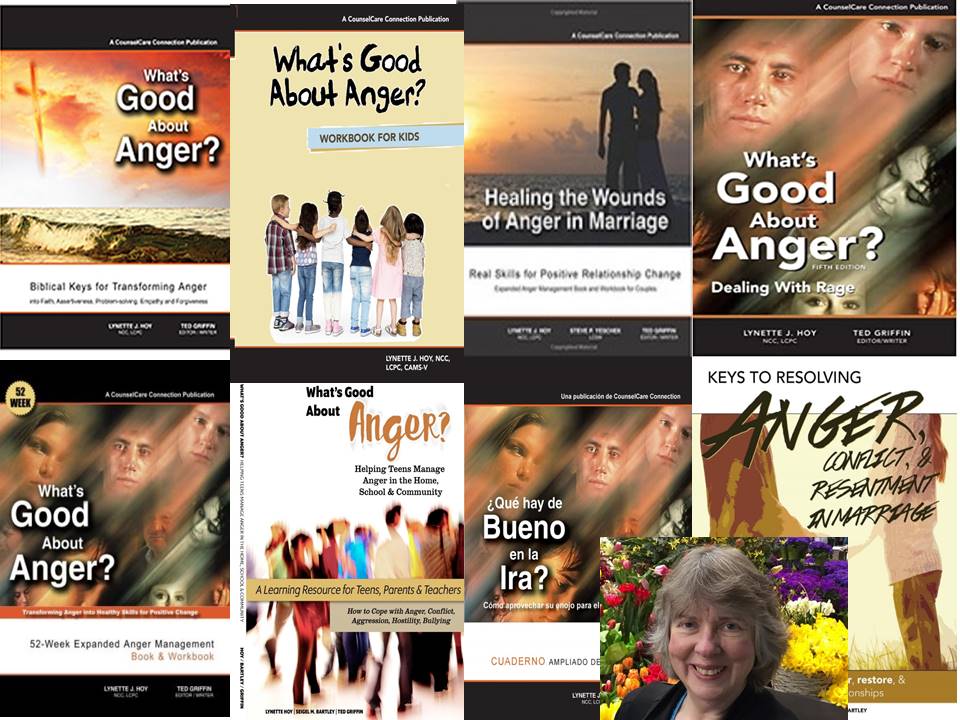
Order the What’s Good About Anger? anger management courses and certificates